Buy-and-Sell Groups vs Facebook Marketplace: When to Use Both


For most sellers, buy-and-sell groups vs facebook marketplace favors using both, because each channel reaches a different set of local buyers. Use Marketplace alone when you need broad exposure, but choose a focused buy-and-sell group when the item suits a clear community. Your best choice depends on the item, your time, and how much buyer screening you’re willing to do.
Buy-and-sell groups and Facebook Marketplace compared
The three practical choices are group-only, Marketplace-only, and posting on both platforms.
| Method | How long | Effort | Cost | Best for |
|---|---|---|---|---|
| Local buy-and-sell groups | Medium | Medium | Low | Niche items and trusted local communities |
| Facebook Marketplace | Fast | Low | Low | Broad local reach and quick listings |
| Groups plus Marketplace | Medium | High | Low | Sellers who want the widest reach |
| Specialist group only | Slow | High | Low | Collectibles, hobby gear, and rare items |
These speed ratings are relative, not promises. Price, condition, and pickup flexibility can matter more than where you post. Check current fees before choosing shipping or checkout options.
Local buy-and-sell groups can bring better conversations because members often share a town, school district, hobby, or interest. The audience may be smaller, though, and each group can have different rules about prices, photos, payment, and pickup.
Read the pinned rules before posting. A missing price or prohibited listing can get your post removed, costing you visibility rather than saving time.
Facebook Marketplace gives your listing a wider local audience and a familiar search system. It can be easier to list an ordinary item there, but you may receive more low offers, repeated questions, and messages from people who never intend to buy.
Using both channels takes more work. You’ll need to track messages, remove sold listings, and avoid promising the same item to two people. In return, you can reach both broad shoppers and buyers who already care about your item.
A specialist group may beat Marketplace for a rare camera lens, trading card, musical instrument, or hobby tool. It may be a poor choice for common household items, where the smaller audience can slow the sale.
Selling through local groups
Buy-and-sell groups work best when the group has a real connection to your item or location. A neighborhood group may suit furniture, children’s items, or appliances. A hobby group may bring more informed buyers for equipment or collectibles.
Start by reading the group rules before posting. Look for limits on listing frequency, allowed items, payment methods, pickup locations, and links to outside pages. Breaking a rule can get your post removed or your account restricted.
Check recent listings before joining or posting. Look for buyer questions and completed sales, not just a large membership count. Repeated spam or unanswered scam reports are reasons to choose another group.
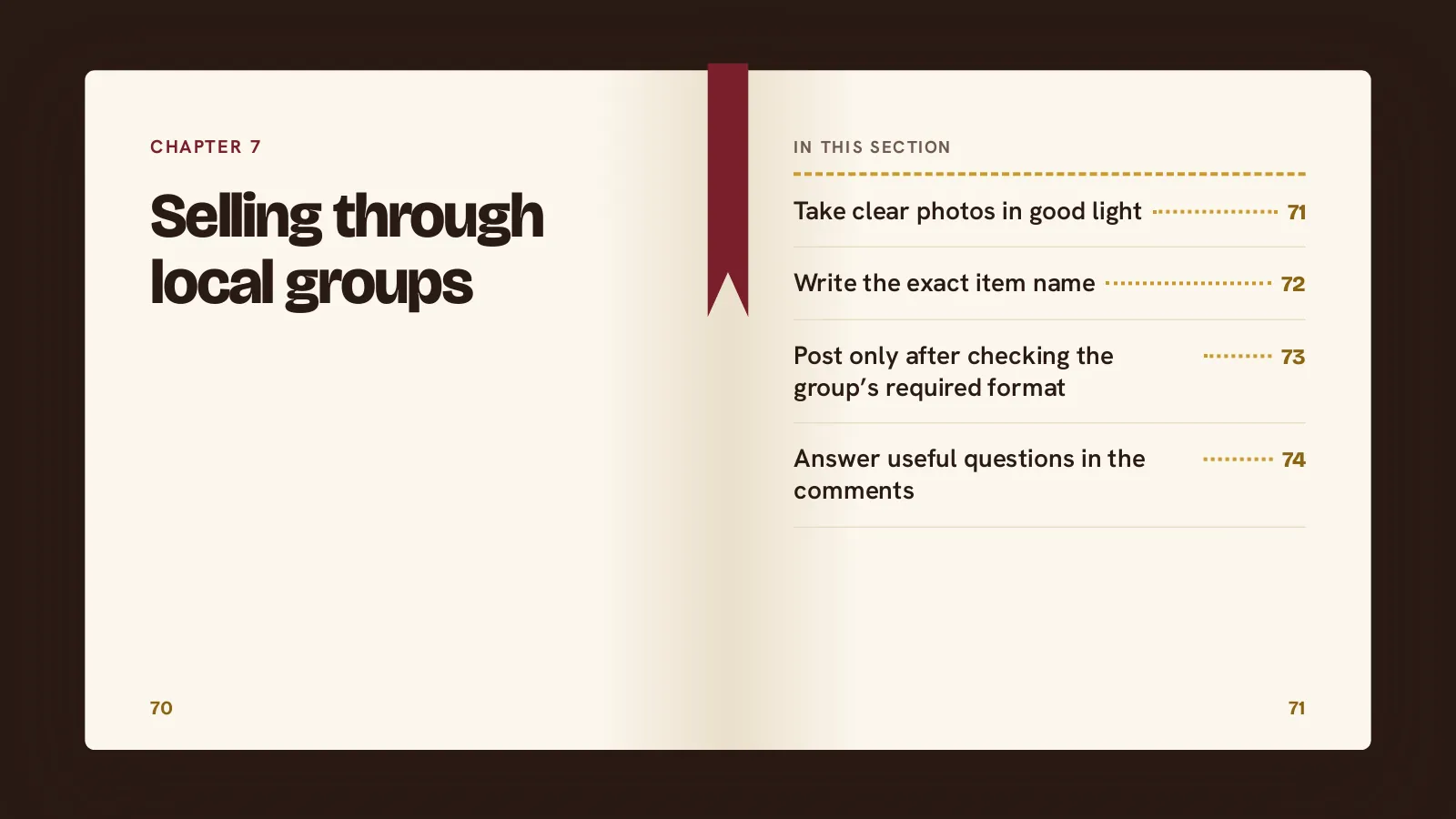
- Take clear photos in good light. Show the front, back, labels, damage, and included accessories.
- Write the exact item name, condition, price, and pickup area. State whether the price is firm.
- Post only after checking the group’s required format. Some groups require a location, price, or sale tag.
- Answer useful questions in the comments. Move private details, such as your address, to a direct message.
- Mark the item sold and delete or close the post after payment and pickup.
Follow any group rules about buyer priority. Agree on a pickup window before holding an item, and tell other interested buyers it’s pending rather than promising it twice.
Groups are good at reaching buyers who understand the item’s value. They can also create more personal trust when members recognize the neighborhood or shared interest.
The weakness is that group quality varies. A quiet group may produce little interest, and a busy group can bury your post quickly. If the item is ordinary, Marketplace usually gives it a larger search audience.
Never share account verification codes or pay a fee to receive a buyer’s payment. Report suspected scams to the platform; contact local authorities if you face threats. For general scam guidance, the Federal Trade Commission explains safer online shopping practices.
Listing on Facebook Marketplace
Marketplace is the simpler starting point for common items. Buyers can search by category, location, and price, so a clean title and accurate details matter more than a clever sales pitch.
Before listing, check the item’s condition and gather everything that comes with it. A missing remote, charger, manual, mounting part, or original case can change what a buyer will offer.
- Choose the correct category and upload several clear photos.
- Use a specific title, such as “IKEA MALM 6-Drawer Dresser, White,” instead of “Nice dresser.”
- Enter the condition, price, location, and measurements. Include defects in the description.
- Reply to serious messages and confirm the pickup time before sharing the exact meeting details.
- Remove the listing as soon as the item sells. If you cross-posted it, close the other post too.
For bulky items, state whether stairs are involved and whether the buyer must bring help. Photograph model labels on electronics and appliances, but cover serial numbers and personal information. Compare asking prices for similar local listings before setting yours; an unsold listing shows what someone wants, not what buyers have paid.
Marketplace is strong when speed and reach matter. It’s also useful when buyers don’t belong to a particular neighborhood or hobby group.
Its trade-off is lower control over the audience. You may get more messages, but some will be vague, very low, or unrelated to the item. A common costly mistake is writing “like new” while hiding damage; it can lead to canceled pickups, angry messages, and a lower final price.
Keep conversations in Messenger, and never share verification codes sent to your phone.
Marketplace isn’t a good fit for sellers who dislike frequent messages or can’t update listings quickly. If the item is rare or technical, a specialist group may produce fewer but more serious buyers.
Who can sell on Marketplace, and what can go wrong
Marketplace is meant for sales between individuals. Businesses, and people selling in a business capacity, can face restrictions in some regions. Meta’s Commerce Policies name the European Economic Area, the Philippines and India.
Meta does not publish an exact minimum account age for Marketplace. Access depends on factors such as your location, your age and the standing of your account. If you don’t see Marketplace, check Meta’s Help Center.
Every listing must follow Meta’s Commerce Policies. A listing that breaks them can be rejected or removed. Repeated or serious breaches can lead to loss of commerce features. A single removed listing does not by itself mean your account is disabled. Some buy-and-sell groups also ban business sellers or reposts, so check each group’s rules.
Posting in groups and Marketplace

Cross-posting combines the broad reach of Marketplace with the focused audience of groups. It can produce the fastest sale, but only when you can manage both listings accurately.
Use one master description so the price and condition stay consistent. Change the opening line slightly for each audience, but don’t create different facts for different buyers.
- Prepare one photo set, one price, and one complete description.
- List the item on Marketplace first, then post it in one or two relevant groups.
- Add a note to yourself showing where each listing appears and when it was posted.
- Reply in one message thread at a time, and confirm the item is still available before agreeing to a pickup.
- The moment the item sells, mark every listing sold or delete the group posts.
This method is strongest for items with a clear local audience and enough demand to justify extra work. It also lets you test whether a general audience or a specialist audience responds better.
The weakness is coordination. If you forget one listing, two buyers may arrange pickup for the same item. That mistake costs time and trust, and it can make both buyers think you’re unreliable.
Cross-posting isn’t for a seller who can’t check messages during the sale period. If you’re in a hurry and can monitor only one place, Marketplace alone is usually safer than creating several posts you might forget.
A fourth option is a dedicated hobby forum or classified site. It can suit rare items, but it’s rarely worth the extra account, rules, and audience research for ordinary local goods.
Which selling option should you use?
The right channel changes with the situation, not just the item. If the item is common, local, and easy to explain, broad reach usually matters more than a highly specialized audience.
When you’re in a hurry
Choose Facebook Marketplace. It’s the fastest option for reaching local shoppers who are already searching by item, category, and location. Use a clear price, several photos, and a firm pickup window.
This choice saves setup time, but you may need to sort through more weak inquiries. If speed matters more than finding the perfect buyer, that extra message work is usually the better trade.
When you’re selling for the first time
Choose a local buy-and-sell group with clear rules and active posts. A focused group can make it easier to see how other members describe similar items, set prices, and arrange pickups.
Read recent posts before listing. If members rarely respond or listings stay open for weeks, use Marketplace instead. A friendly-looking group isn’t useful if it has little current activity.
When you want the best possible result
Choose groups plus Marketplace. Cross-posting gives you the widest chance of finding a buyer who accepts the item’s condition and price.
The cost is more tracking and more messages. If you’re willing to manage both listings carefully, wider exposure can be worth the extra work; if not, one accurate listing is better than two neglected ones.
For expensive or specialized items, start with a relevant group and add Marketplace only if the group gets no serious interest. For ordinary household goods, start with Marketplace and use a neighborhood group as a second channel.
Rules for safer Facebook selling
The platform changes, but the basic selling work stays the same. Accurate details, controlled communication, and a clear handoff matter more than whether the listing appears in a group or Marketplace.
Prepare the item before posting. Clean it, test it, measure it, and photograph damage. Keep the price, condition, brand, model, and included parts identical across every listing.
Check progress partway through the sale. If you receive views but no serious messages, improve the first photo or rewrite the title. If people repeatedly ask about a missing detail, add that detail to the description.
Keep private information private. Don’t post your full home address, account passwords, one-time codes, or copies of sensitive documents. Arrange a public meeting when practical, and bring another adult for a valuable or bulky item.
For home pickup, move the item to a garage or entryway if possible. Share the address only after agreeing on a pickup time, and keep buyers out of other rooms.
Keep messages on Facebook so you retain the conversation history. Reject requests to pay a fee to receive money or refund an overpayment; both are common scam tactics.
At the end, confirm payment before handing over the item. Don’t rely on a screenshot or an email claiming that money is coming. For payment disputes, threats, suspected fraud, or account problems, stop the transaction and contact your payment provider, Meta support, or local law enforcement.
There’s no single response rate or selling time that applies to every listing. You can judge your result by the item’s demand, your local audience, the price, and the quality of your photos and description.
Related guides
- How to Schedule Posts in a Facebook Group: A Step-by-Step Guide
- How to Use Guides in a Facebook Group: Step-by-Step Setup
When you want it set up without the guesswork, Facebook Marketplace Account Setup is the place to start.
Frequently asked questions
Can you post the same item in a buy-and-sell group and Marketplace?
Yes, you can post in both if each group allows it and the details stay consistent. Tracking listings and pausing the others when someone commits, until payment and pickup are complete, helps prevent double-booking and wasted buyer trips. Check group rules first: some require a separate post rather than a Marketplace share.
Why do people use buy-and-sell groups?
People use buy-and-sell groups because the audience may share a location, school area, hobby, or interest. That focus can help a specialized item reach buyers who understand its value. Groups also let members see local sales activity and common asking prices. However, a group’s name doesn’t guarantee that it’s active or trustworthy. Check recent posts, moderator rules, and the way members handle disputes before relying on it for an expensive sale.
How long does it take to sell on Facebook Marketplace?
A common item may sell within a few days when the price, location, photos, and condition match local demand. That isn’t a promise, because a rare item or high asking price can stay listed much longer. Review the listing after 3 to 7 days without serious interest. Improve the first photo, add measurements, or adjust the price only after comparing similar local listings.
Is it safe to meet a Facebook Marketplace buyer at home?
No, meeting at home isn’t the safest default for valuable or personal items. Use a busy public location when the item can be carried there, and tell someone where you’re going. For furniture or appliances that must stay at home, keep the item near an entrance, remove private belongings from view, and have another adult present. Don’t share your full address until the buyer has confirmed a specific pickup time.
What happens if a buyer says they paid but you don’t see the money?
Don’t hand over the item until the payment appears in your own bank or payment account. A screenshot, email, or text message can be fake or altered. Open the payment app yourself rather than using a link in the message. If the buyer pressures you, changes the payment method, or asks for a code, cancel the deal and report the account through the platform.
Can you sell anything in a Facebook buy-and-sell group?
No, group membership doesn’t override Facebook’s commerce rules or local law. Restricted items can include weapons, illegal goods, certain animals, counterfeit products, and other controlled goods. The exact rules can change, and individual groups may be stricter. Check Meta’s current Commerce Policies and the group’s pinned rules before listing. If the item involves a license, transfer record, or legal restriction, use the proper regulated process instead.
What to do next
For your next sale, try the channel that feels like the best fit for your item and schedule. You don’t need to reach everyone; you need to reach someone who’s ready to buy. Treat that listing as a small test to help you choose where to sell in the future.

Derek Campbell writes about Facebook features, tools, and account management, covering topics such as account troubleshooting, Business Manager, Facebook Marketplace, and outreach strategies. His content also explores Facebook Groups, community engagement, and ways to connect with relevant audiences. His writing emphasizes practical Facebook know-how, from navigating Marketplace and managing business communities to building meaningful connections through Groups and outreach.
Checked against Facebook’s own help and policy pages on the date shown above.