How to Sell Handmade Items on Facebook Marketplace


Selling handmade items on Facebook Marketplace starts with clear photos, an honest description, a fair price, and safe local selling. The best results usually come from listing one finished item at a time, answering messages quickly, and confirming the pickup details before meeting.
Your price, item size, local demand, shipping choice, and Facebook account settings can change the result. This guide suits sellers offering finished crafts locally, not businesses that need a full online store, advanced inventory tools, or international delivery.
Who Facebook Marketplace suits
Facebook Marketplace works well for a crafter with finished items, basic photos, and a local pickup option. You might sell candles, artwork, sewn goods, woodwork, jewelry, home décor, or seasonal gifts. You’ll need enough product information to answer questions about size, materials, care, and pickup.
A second reader may already sell at craft fairs but wants more local buyers. That seller mainly needs a repeatable listing format, better pricing, and a way to avoid long message chains. A new seller may instead need help choosing photos, writing the first description, and spotting unsafe requests.
This page serves sellers with small or medium batches who can arrange local pickup or follow Facebook’s available shipping rules. It assumes your item is legal to sell, you own the design or have permission to use it, and you can check your local tax and business requirements.
It’s not the right guide for a company that needs stock syncing, staff accounts, wholesale orders, or detailed customer records. That seller should compare a dedicated store platform with Facebook Marketplace before listing.
What changes your sale
Your local demand matters most. A handmade winter wreath may sell quickly in November but slowly in July. Search Facebook Marketplace for similar finished items in your area, then compare their prices, photo quality, age, and number of visible inquiries.
The item’s use changes the wording and price. A decorative bowl, a child’s toy, and a scented candle need different details. Check the material, intended use, dimensions, and care instructions before writing the listing. Never describe an item as food-safe, non-toxic, certified, or child-safe unless you can support that claim.
The total price changes with size and effort. Add material cost, packaging, platform-related charges if shown, travel, and your labor. If the total is higher than similar local products, explain the difference through materials, size, personalization, or finish rather than hiding it.
Your selling method affects the workload. Local pickup avoids packing and shipping problems but reduces your audience. Shipping may reach more buyers, but it adds packaging, postage, damage risk, and return questions. If the item is fragile or one-of-a-kind, local pickup is usually easier to control.
A detail sellers often get wrong is the finished item’s size. Measure it after assembly, including handles, frames, lids, or hanging parts, and photograph the measuring tape when the size could be misunderstood.
How to List Handmade Items on Facebook Marketplace
Use these steps for one finished item. They assume you’re creating a standard Facebook Marketplace listing on a current mobile or desktop version; button names can change, so follow the labels shown in your account.
-
Finish and inspect the item. Check seams, edges, hardware, surfaces, and moving parts. Don’t list it until it matches the condition you’ll describe. The item should look complete in your final inspection.
-
Measure the finished item. Record height, width, depth, weight if shipping matters, and any usable interior space. Measure the assembled product, not only the pattern or raw materials. Your notes should match the photos and description.
-
Take five to eight clear photos. Use daylight or bright even lighting, a simple background, and a photo of the full item. Add close views of texture, labels, hardware, flaws, scale, and included parts. The first photo should show the whole product without heavy editing.
-
Choose a direct title. Name the item, its main material or style, and its key use. For example, “Hand-painted ceramic planter, blue, 6-inch” gives more useful information than “Beautiful handmade gift.”
-
Select the closest category. Choose the category that matches what the buyer will use the item for. Avoid unrelated categories just because they appear busy. The completed preview should show the correct category and location.
-
Set the price after checking similar listings. Compare at least five nearby items with similar size, condition, and purpose. Price your item in whole dollars unless a precise amount has a clear reason. If you’ll accept less, state “offers considered” rather than adding an inflated price.
-
Write the description. State what it is, what it’s made from, its measurements, condition, care instructions, personalization options, price, and what’s included. Add the pickup area and whether delivery or shipping is available. The buyer shouldn’t need to ask basic questions.
-
Review the listing before publishing. Check spelling, measurements, price, location, photos, and availability. Remove claims you can’t prove. The preview should show the exact item, not a similar finished piece.
-
Answer serious messages clearly. Confirm the item, price, pickup place, payment method, and meeting time. If the buyer asks for a verification code, unusual payment, or a move to a suspicious link, stop the conversation and report it.
-
Mark the item pending or sold promptly. Update the status after a confirmed handoff or payment. This prevents new buyers from arranging a meeting for an item that’s no longer available.
The key judgement call is whether the listing describes the actual finished item. A polished photo can make an incomplete, smaller, or flawed product look better than it is, and that mismatch costs trust, time, and sometimes a refund.
If a product involves regulated safety claims, electrical work, children’s use, cosmetics, food contact, or a legal permit, stop before making the claim and ask the relevant regulator or a qualified professional.
Listing choices at a glance

Your best approach depends on the item’s risk, size, and buyer expectations.
| Situation | What to do | What it takes | What to watch for |
|---|---|---|---|
| Small sturdy item | Offer local pickup | Simple photos | Low local demand |
| Fragile decoration | Show close details | Careful packing | Breakage disputes |
| Personalized order | List sample design | Extra messages | Unclear expectations |
| One-of-a-kind piece | State exact item | Fast replies | Duplicate inquiries |
| Seasonal product | List before demand | Timely promotion | Short selling window |
| Large furniture | Add exact dimensions | Pickup planning | Transport problems |
| Repeatable craft | Show finished example | Batch preparation | Stock mismatches |
Details that improve handmade listings
Prepare the item first
Clean loose threads, dust, fingerprints, and packaging marks before taking photos. Keep the background plain enough that buyers can see the shape and color. If the color changes under indoor light, include one photo near a window and describe the color in simple words.
Experienced sellers also prepare answers before publishing. Write down the dimensions, materials, care method, production time, pickup area, and personalization limits. This reduces repeated messages and helps you give the same answer to every buyer.
Don’t photograph a similar item and imply it’s the exact one. If grain, paint, fabric pattern, or glaze varies, say so. Buyers can accept natural variation when you explain it before the sale.
Check the buyer’s view
Read the listing as someone who doesn’t know your process. Can they see the scale, finished condition, price, and included parts without opening several messages? If not, add a photo or rewrite the first two lines.
Leave out claims that sound stronger than your evidence. The Federal Trade Commission says advertising claims should be truthful, not misleading, and supported by evidence when needed; its advertising and marketing basics explain that standard.
A common mistake is leading with “custom” while giving no options, measurements, or deadline. That attracts questions you can’t answer, wastes time, and can create an order you can’t complete. If the item is ready now, say “ready to pick up”; if it’s made to order, give the production time you can actually meet.
Common listing problems and fixes
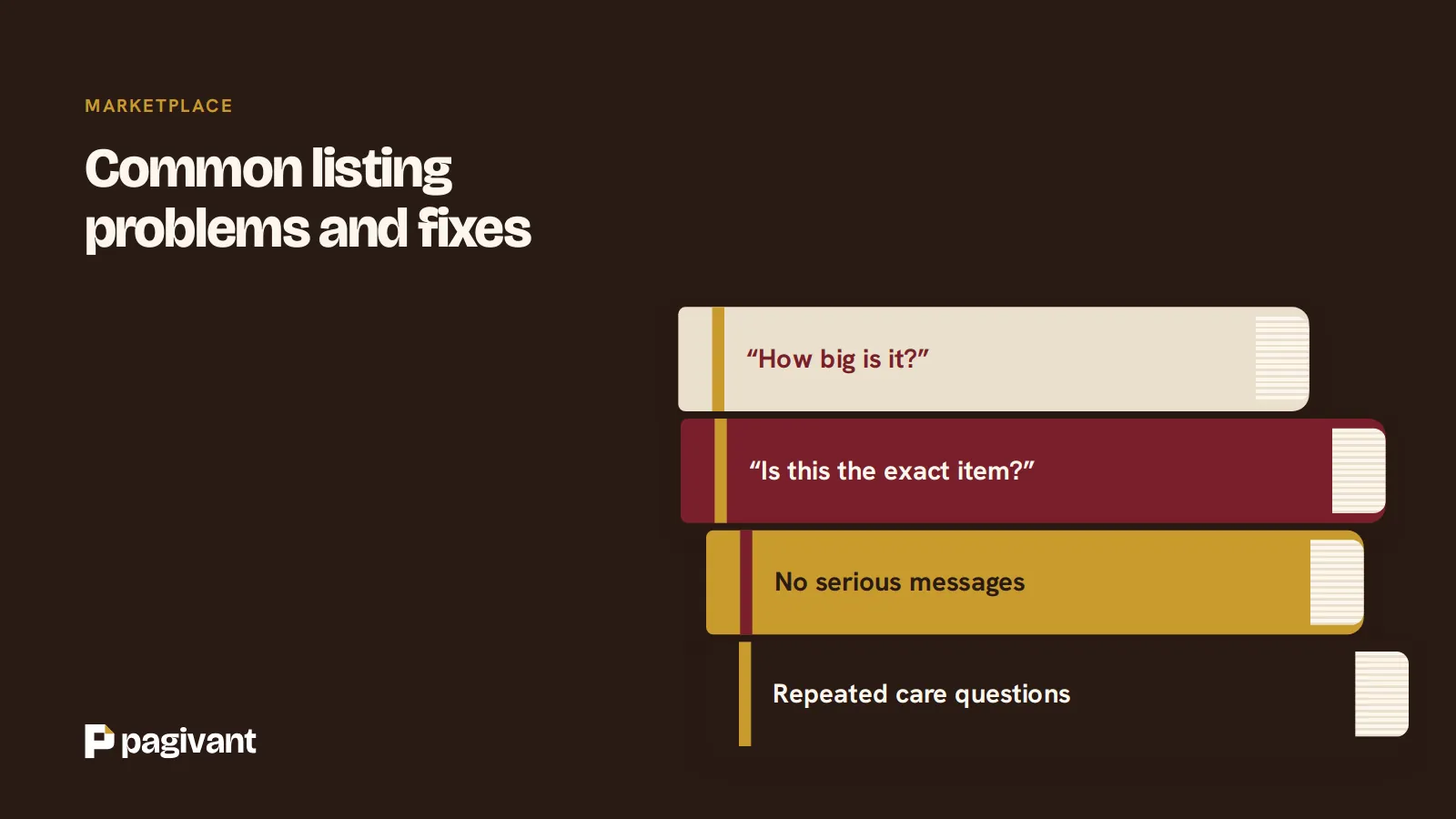
A buyer’s question often shows that one part of the listing is missing or unclear.
| What you notice | What it usually means | What to do first | How to stop it happening again |
|---|---|---|---|
| “How big is it?” | Measurements are missing | Add all dimensions | Photograph a ruler |
| “Is this the exact item?” | Photos show samples | Label each photo | Show finished item |
| No serious messages | Price or photos miss | Compare local listings | Improve first image |
| Repeated care questions | Instructions are absent | Add care details | Use a standard template |
| Pickup keeps changing | Details aren’t confirmed | Restate time and place | Confirm before travel |
| Buyer asks for code | Possible scam attempt | Stop and report | Never share codes |
| Item looks different | Lighting changed color | Send honest photos | Use neutral daylight |
If Meta removes a listing
A removed Marketplace listing is judged against Meta’s Commerce Policies. Marketplace does not have a separate rulebook. A removal does not by itself mean your account is disabled.
Read the notice, compare your listing with the Commerce Policies, and fix what broke the rules before you post again. Breaking the policies can lead to more rejected or removed listings. It can also lead to suspended access to commerce features. Use the review options in Meta’s Help Center if you think a decision was wrong. No guide or service can promise that Meta will approve an appeal.
Rules for handmade sales
Facebook Marketplace rules can vary by country, account type, product category, and whether you offer shipping. Read the current Meta Commerce Policies and Marketplace rules inside your account before listing an item that involves health claims, animals, weapons, alcohol, adult content, branded designs, or regulated goods.
Your local law may also control business registration, sales tax, labeling, product safety, and home-based production. The right source depends on your state, city, and product. Check your state tax department, local licensing office, and the regulator for the product category.
Don’t copy logos, characters, brand names, patterns, or photographs that you don’t own or have permission to use. A handmade item can still create intellectual-property problems if its design uses protected work.
If a product could harm someone through electrical, chemical, food, cosmetic, or child-use risks, don’t guess at compliance. Stop and ask the relevant government agency or a qualified professional before selling it.
Selling as a business
Facebook Marketplace is meant for consumer-to-consumer sales. Businesses, and people acting in a business capacity, can face restrictions in some regions. Meta’s Commerce Policies name the European Economic Area, the Philippines and India.
Restrictions can include suspended Marketplace access or removed listings. If you sell handmade items on a regular basis, read the current Commerce Policies before you list. Also check whether Meta’s other commerce tools suit your plans better.
What selling really costs
The visible price isn’t the full cost of a Marketplace sale. You may spend time making the item, photographing it, writing the listing, answering messages, arranging pickup, traveling, packing, and handling cancellations.
Calculate your minimum price before publishing. Add materials, packaging, paid tools, transaction charges shown by Facebook or your payment provider, travel, and labor. If you don’t know your labor value yet, record the minutes spent on one item and compare that effort with the money left after direct costs.
Local pickup can reduce postage and packing costs, but it may require more messages and travel. Shipping can expand your audience, but the item must be packed for movement and the delivery price must be checked for the package’s actual size and weight.
Your current tax and reporting duties depend on where you live and whether the activity is a hobby or business. Check your tax authority’s current guidance instead of relying on an old social-media post. These rules can change, and Marketplace doesn’t replace your local records.
Keeping listings accurate
Keep a simple record for each item: listing date, materials, price, buyer messages, payment, pickup or shipping status, and final result. A spreadsheet or notebook is enough if it contains the information you’ll need later.
Remove sold listings or mark them sold as soon as the handoff is complete. If the item is temporarily unavailable, update the status rather than leaving buyers to guess. Review active listings when material costs, sizes, colors, or availability change.
Save the original photos and description for repeat designs. Don’t reuse them without checking that the new item has the same measurements, finish, and included parts. If the new version differs, update the listing before publishing.
The listing needs attention again when the price no longer covers your costs, the item’s condition changes, or buyers ask the same unanswered question. Fix the description first; don’t start over unless the photos or category are fundamentally wrong.
When Marketplace isn’t the right choice
Facebook Marketplace isn’t ideal for a made-to-order business with many options, deposits, repeat customers, and delivery deadlines. Use a dedicated online store or an order form when you need structured choices and automatic records.
It’s also a poor fit for fragile, high-value, or difficult-to-transport work if you can’t pack and insure it properly. Sell through a local gallery, craft fair, or specialist channel that already handles that type of item.
Don’t use this approach when the product needs a professional safety review, license, or regulated label. Ask the relevant regulator or qualified professional first, and sell only after you meet the required rules.
Want an expert to set this up with you? Take a look at Facebook Marketplace Account Setup.
Frequently asked questions
Can I sell handmade items on Facebook Marketplace?
Yes, you can sell many handmade products if they follow Meta’s Commerce Policies and local laws. Marketplace is meant for consumer-to-consumer sales, so businesses can face restrictions in some regions. The item must be accurately described, legally yours to sell, and shown with honest photos. Restricted products, copied designs, and unsupported safety claims can cause problems.
Why is my handmade listing not getting views?
Low views usually come from a weak first photo, a wrong category, an unclear title, limited local demand, or a price above comparable items. Search five similar listings nearby and compare their photo, title, price, age, and pickup location before changing yours.
How much should I charge for handmade items?
Charge enough to cover materials, packaging, selling costs, labor, and a reasonable profit. Compare five similar local products with similar size and finish. If your price is higher, explain the added value; don’t hide the difference with vague words like “premium.”
How long should a Facebook Marketplace listing stay active?
There’s no single useful number of days for every handmade item. Review it when views, messages, or local comparable listings change. Seasonal goods need earlier attention, while a unique item may need better photos or pricing rather than simply more time online.
Is it safe to meet a Marketplace buyer?
Local pickup is safer when you use a public place, tell someone your plan, keep communication on Facebook, and avoid sharing unnecessary personal details. Don’t meet alone in a private location if the buyer’s behavior feels threatening or inconsistent.
What happens if a buyer cancels?
You can relist or contact the next interested buyer after confirming the first sale is no longer happening. Keep the item’s status accurate, and avoid making a trip until the buyer confirms the time and place.
Does it matter if my handmade item is one of a kind?
Yes, because the buyer needs to know whether the photos show the exact item or only an example. Use “one of a kind” only when no identical item exists, and explain any natural differences in color, grain, texture, or finish.
Can I ship handmade items through Marketplace?
Only use shipping when the option is available for your account and product, and when you can package the item safely. Check the current shipping instructions shown by Facebook, then confirm the buyer’s total cost before accepting the order.
What to do first with handmade listings
Start with one finished item, measure it, photograph it in clear light, and compare five similar local listings before setting the price. A successful listing gets questions about pickup or purchase, while a request for a code, unsafe meeting, or unsupported product claim means you should stop and get help.

Derek Campbell writes about Facebook features, tools, and account management, covering topics such as account troubleshooting, Business Manager, Facebook Marketplace, and outreach strategies. His content also explores Facebook Groups, community engagement, and ways to connect with relevant audiences. His writing emphasizes practical Facebook know-how, from navigating Marketplace and managing business communities to building meaningful connections through Groups and outreach.
Checked against Facebook’s own help and policy pages on the date shown above.