How to Sell Baby Items on Facebook Marketplace


Usually, selling baby items on Facebook Marketplace starts with verifying they’re safe to resell, then posting clear photos and an honest price. If you skip the safety check, you could pass on a recalled product that could seriously injure a child.
Start with items you can identify and describe accurately, such as outgrown clothes, books, or a stroller with its label and instructions. A working buckle or a clean cover doesn’t prove that baby gear is safe.
If you can confirm the item’s identity, condition, and resale eligibility, prepare the listing; if you can’t, hold it back. This approach isn’t for clearing everything at any cost. Some products need a manufacturer’s answer, and some shouldn’t enter the secondhand market at all.
Which baby items can you sell?
Clothing and books usually need simpler checks than products used for sleep, feeding, or travel. The US Consumer Product Safety Commission, or CPSC, tells resellers to check products for recalls and compliance before selling them.
Use this table as a starting point, not proof that your particular item qualifies. Meta’s Commerce Policies also apply, so check the current rules for your category before publishing.
| Situation | Safe? | Why |
|---|---|---|
| Clean clothing with intact fasteners | Yes | Check recalls and describe wear |
| Books with intact pages | Yes | Check recalls and physical condition |
| Complete stroller with readable label | With care | Verify recalls and required parts |
| Car seat with unknown history | No | Crash history can’t be confirmed |
| Crib with missing hardware | No | Missing parts can affect safety |
| Recalled item without completed remedy | No | Federal law prohibits recalled product sales |
| Opened formula or baby food | No | Don’t offer opened consumable products |
Search recalls using the manufacturer, model number, and manufacture date, not just the product name. Similar-looking models can have different recall status. If identifying labels are missing, don’t guess.
For car seats, also check the manufacturer’s expiration guidance and instructions about replacement after a crash. For cribs, don’t substitute generic hardware; obtain the correct parts and assembly instructions from the manufacturer.
Meta’s rules for baby item listings
Marketplace listings must follow Meta’s Commerce Policies. These policies cover any attempt to sell or trade a product, even for free. They also prohibit recalled products, so a recall check protects your listing as well as the buyer.
Marketplace is meant for consumer-to-consumer sales. People acting in a business capacity can face restrictions in some regions, including the European Economic Area, the Philippines and India.
A listing that breaks the rules can be rejected or removed. Breaking them can also lead to suspended access to commerce features. A removed listing does not by itself mean your account is disabled. Read the current policy for your item’s category before you post.
Baby item resale risks to check

A recall check comes before pricing or cleaning. The CPSC states that selling recalled consumer products is unlawful, including secondhand sales. Its resale information center explains the responsibilities of resellers. Search using the brand, model, and identifying dates rather than relying on a product photo.
An item can look good while still having a safety problem. A recall may concern a part or design issue that isn’t visible in your listing pictures. The CPSC’s recall notice and the manufacturer’s instructions should decide your next step, not whether the previous owner reports trouble-free use.
Car seats need a history check, not just a condition check. The National Highway Traffic Safety Administration’s used-seat checklist covers crash history, labels, recalls, instructions, and parts. If you can’t answer those questions, don’t offer the seat as ready to use. A buyer can’t recover that missing history by inspecting the fabric.
Check the manufacturer’s expiration guidance, too; the purchase date alone doesn’t establish a seat’s remaining usable life. Don’t sell an expired seat for continued use.
Sleep products deserve particular caution. The CPSC says older cribs may not meet current standards, and traditional drop-side cribs can’t legally be resold. Don’t describe a product as suitable for overnight sleep merely because a baby previously slept in it. Check its intended use in the manufacturer’s manual.
Missing information can turn an ordinary sale into a dispute. Calling a stroller “excellent” while leaving out a sticking brake gives the buyer a different picture from reality. Describe observable wear, but don’t use disclosure as permission to sell unsafe equipment. A safety defect needs resolution before listing, not a discount.
Compare the assembled item with the manual’s parts list. Missing harness straps, fasteners, or locking components aren’t cosmetic flaws. Ask the manufacturer about approved replacements rather than improvising with hardware that merely fits.
Payment and pickup bring separate risks. The Federal Trade Commission warns about fake payment notices and buyers who ask sellers to return an alleged overpayment. Check the payment inside your own account rather than trusting a screenshot or email. Don’t send money to release a payment.
There’s no reliable risk percentage for your individual listing. The useful checks are product identity, recall status, completeness, and transaction details. Your item’s model and manufacture date vary; read both from its attached label before choosing the matching recall notice or manual. If the label is unreadable, ask the manufacturer rather than choosing the closest-looking product.
When to stop a baby item sale
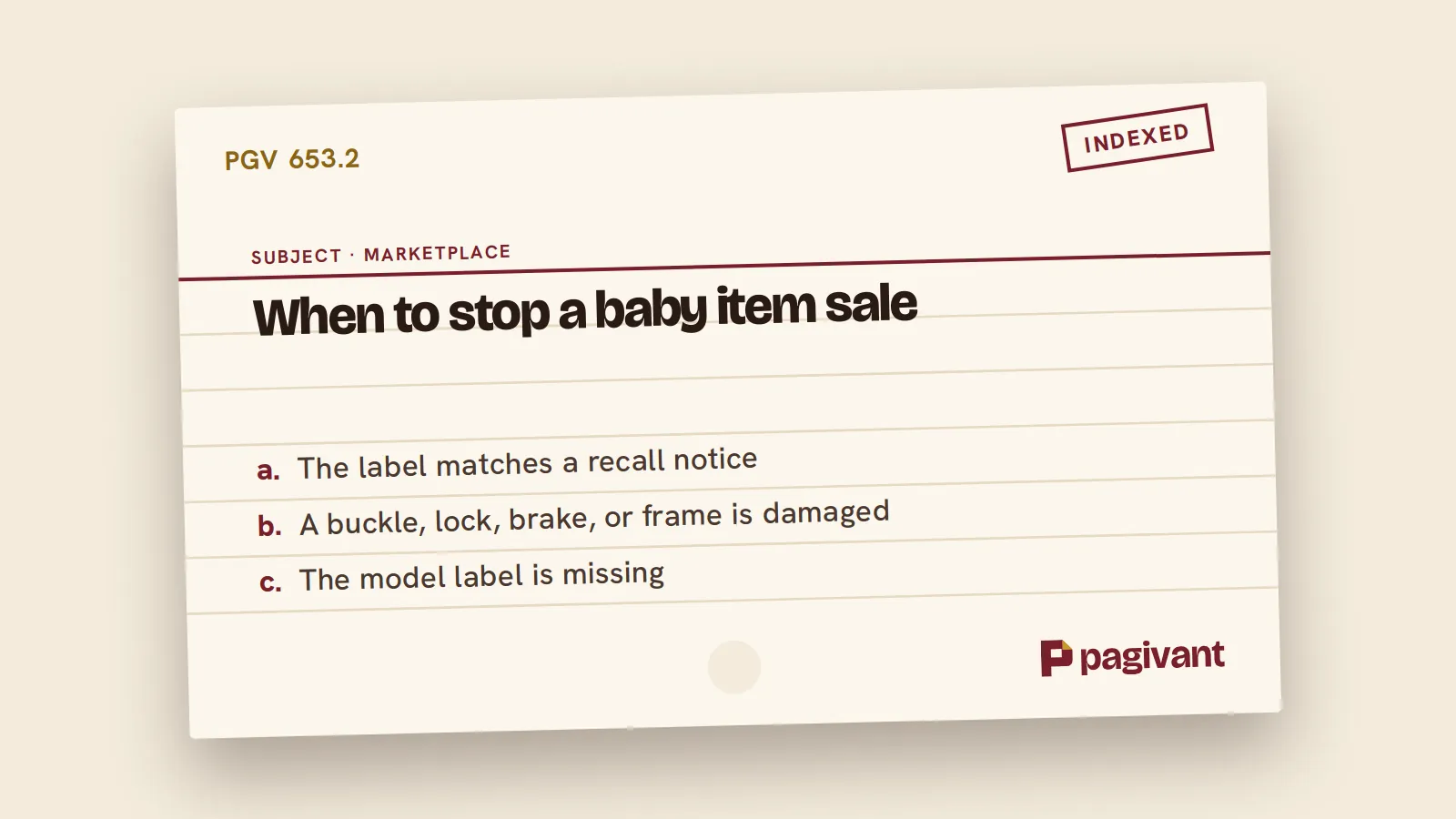
Pause the listing whenever you find information that you can’t verify or a defect affecting use. The CPSC’s reseller guidance supports checking safety before offering the item, rather than asking a buyer to accept the uncertainty.
These signals need action before pickup. They aren’t a complete safety test: the absence of visible damage doesn’t rule out a recall or hidden problem.
- The label matches a recall notice: the product needs the official remedy or disposal instructions. Don’t sell it while you’re still checking whether that remedy applies.
- A buckle, lock, brake, or frame is damaged: a working part may no longer perform as intended. Stop demonstrating or offering it until the manufacturer advises you.
- The model label is missing: you may be unable to identify the correct instructions or recall status. Don’t substitute a similar model’s paperwork.
- Required hardware is missing or improvised: the product isn’t complete as designed. Ask the manufacturer about approved parts; don’t fit household substitutes.
- A buyer requests a verification code or refund: stop the transaction and check your account independently. The FTC identifies code requests and overpayment stories as scam warning signs.
Photograph identifying labels before contacting the manufacturer, including the model number and manufacture date if present. If a previous owner claims a recall repair was completed, ask for documentation rather than relying on appearance.
For a claimed overpayment, don’t send money through a separate payment app. Check the original transaction through the service’s official app or website, not a buyer’s link.
Safety-critical repairs and uncertain product identification are beyond a routine home resale check; contact the manufacturer.
Steps to list baby items for sale
Prepare the product before opening the listing form. It’s easier to write an accurate description when you’ve already checked its label, parts, instructions, and condition.
-
Identify exactly what you’re selling. Read the brand, model, size, and manufacture date where available. Compare those details with the manufacturer’s manual and CPSC recall information. Check Meta’s current Commerce Policies too. Keep any item with unresolved safety or eligibility questions out of your sale pile.
-
Clean it according to its care instructions. Use the garment label or product manual to choose the washing method and any permitted cleaner. Don’t guess at chemical strength or soaking time. For car seats, follow the manufacturer’s specific harness-cleaning directions rather than treating straps like ordinary laundry.
-
Choose a single item or a useful bundle. Group clothes by the same labeled size and describe the season and item count. Separate higher-value gear so buyers can search for its model. Bundles reduce messages and pickups, but selling items separately gives buyers more choice and may bring a better total.
-
Set your price from close comparisons. Search Facebook Marketplace for the same model or a genuinely similar clothing bundle in your area. Compare condition, included parts, and asking prices. Active listings show what sellers want, not what buyers actually paid. Choose your starting price and private minimum before answering offers.
-
Photograph the actual contents clearly. Include a full view, the identifying label, included accessories, and close-ups of wear. For clothing bundles, lay everything out so buyers can count it. Avoid using only stock photos: they don’t show your item’s condition and can leave buyers expecting accessories you aren’t including.
-
Write a searchable, factual listing. In Marketplace, choose the relevant sale category and enter the price, condition, photos, and description. Use a title such as “Baby clothes bundle, size 6–9 months, 12 pieces” only when those details match. Name missing nonessential extras and cosmetic wear without hiding them behind “normal condition.”
-
Agree on pickup and payment before meeting. Confirm the item, final price, pickup area, and payment method in the message thread. Use an appropriate public meeting location where practical. For bulky home pickups, keep buyers outside your living space when possible. Verify payment yourself before handing over the item, then update its listing status.
If a baby item sale goes wrong
First, stop any handover that hasn’t happened yet. If you discover a recall or a safety concern, take down or pause the listing. Save the model details and the relevant notice so you can explain the problem accurately instead of making a vague claim.
Check the model number and manufacture date against the recall notice; a similar product name alone may not identify the affected item. Keep recalled items out of circulation, including donations.
If the buyer already has the product, contact them promptly through the existing conversation. Tell them the exact concern and direct them to the manufacturer or CPSC notice. If the notice says to stop using the product, pass that instruction on clearly. Don’t suggest a homemade repair or promise that the problem is harmless.
For a condition dispute, compare the complaint with your saved listing and photos. A missing accessory, an incorrect size, and a safety defect need different responses. Discuss a return or refund honestly, and keep the agreement in writing. Don’t claim that “all sales final” removes every responsibility; applicable state law and platform rules still matter.
Before arranging a return, agree on which parts come back, who pays shipping, and when the refund will happen. Photograph the returned item and retain tracking.
For suspected payment fraud, check your own account before responding further. Contact your bank or payment provider using its official app or published contact details. Don’t send a separate refund for money you can’t verify receiving. Save messages and report the account to Meta.
Stop handling the issue alone when there’s injury, threats, or a legal demand. Seek medical care for an injured child, contact police for immediate danger, and get qualified legal advice for a formal claim. Product-safety repairs belong with the manufacturer or its authorized service provider.
When you want it set up without the guesswork, Facebook Marketplace Account Setup is the place to start.
Frequently asked questions
Check the product details before relying on general selling advice. These answers cover listing choices and buyer questions, but they don’t replace the item’s manual or Meta’s current rules.
Can I sell baby clothes as a bundle?
Yes, a clearly described clothing bundle can reduce the work of creating listings and arranging pickups. If sizes vary or items show wear, describe those details rather than hiding them.
Why is my baby item listing getting no messages?
A weak match between your price, photos, and local demand can leave a listing without messages. Comparing similar items and checking your main photo, title, category, pickup area, and description can reveal missing details. A quiet listing alone doesn’t prove your account is restricted.
How long should I hold a baby item for a buyer?
The agreed pickup deadline should decide the hold, with the date and local time stated before you reserve the item. Pickup arrangements can differ for a bulky crib and a clothing bag. If the buyer misses the agreement, message them before moving to the next buyer.
Is it safe to post my home address on Marketplace?
No, don’t put your full home address in a public listing when an approximate pickup area will do. Meta provides privacy and scam guidance for reviewing information visible on your listing and profile. Share detailed pickup instructions only after agreeing on the sale, without revealing household routines or when nobody’s home.
What happens if a buyer asks me to ship baby gear?
Shipping adds packing, cost, payment, and dispute questions to settle before accepting an offer. Measuring and weighing the packed parcel lets you quote postage rather than guess from the unpacked product. If you can’t package the gear without risking damage or losing essential parts, keep the listing limited to pickup.
Does it matter if the baby item has no box?
Usually, the missing box matters less than missing identification, instructions, or required parts. The manufacturer may provide the correct manual for the exact model, but don’t describe a download as original paperwork. For collectibles or gifts, packaging may affect price, so compare with similarly unboxed listings.
What to do next
Choose one outgrown item to sell this week, rather than trying to clear the whole nursery at once. You don’t have to turn every spare moment into a selling session. A small start can make the task feel easier and leave you with a little more space at home.

Derek Campbell writes about Facebook features, tools, and account management, covering topics such as account troubleshooting, Business Manager, Facebook Marketplace, and outreach strategies. His content also explores Facebook Groups, community engagement, and ways to connect with relevant audiences. His writing emphasizes practical Facebook know-how, from navigating Marketplace and managing business communities to building meaningful connections through Groups and outreach.
Checked against Facebook’s own help and policy pages on the date shown above.