How to Grow a Facebook Page Without Buying Likes: Real Strategies

To grow a Facebook page without buying likes, publish useful posts for a clear audience, join real conversations, and use your results to choose what to repeat. The work is easy to start, but building a steady audience takes ongoing effort, not one setup session. You must have working access to the Page before you begin.
Plan around the time you can spend creating posts and answering people, rather than a promised follower deadline. You can start without an advertising budget if you make the content yourself; photography, editing, and staff time may add costs. This approach isn’t for anyone who needs guaranteed reach or immediate sales. It favors relevant followers over a fast, impressive-looking total.
What you need for Facebook page growth
You don’t need a paid scheduling tool or a large content library to begin. You do need a clear reason for someone to follow, plus a way to track whether your posts deliver it.
| Item | How much | Why it’s needed | A substitute |
|---|---|---|---|
| Facebook Page access | One Page you can manage | Publish and review your content | None — don’t swap this |
| Audience description | One clearly defined reader group | Keep posts useful and focused | Notes from actual customer questions |
| Page details | All relevant public information fields | Explain your offer and contact options | None — don’t swap this |
| Original content material | Enough for your planned publishing slots | Give people reasons to return | Permission-based contributions from your community |
| Content calendar | One shared or personal calendar | Match publishing to available time | A simple dated paper planner |
| Results tracker | One sheet with consistent reporting periods | Compare posts against your goal | Available Meta Business Suite reports |
Prepare your Facebook page before posting
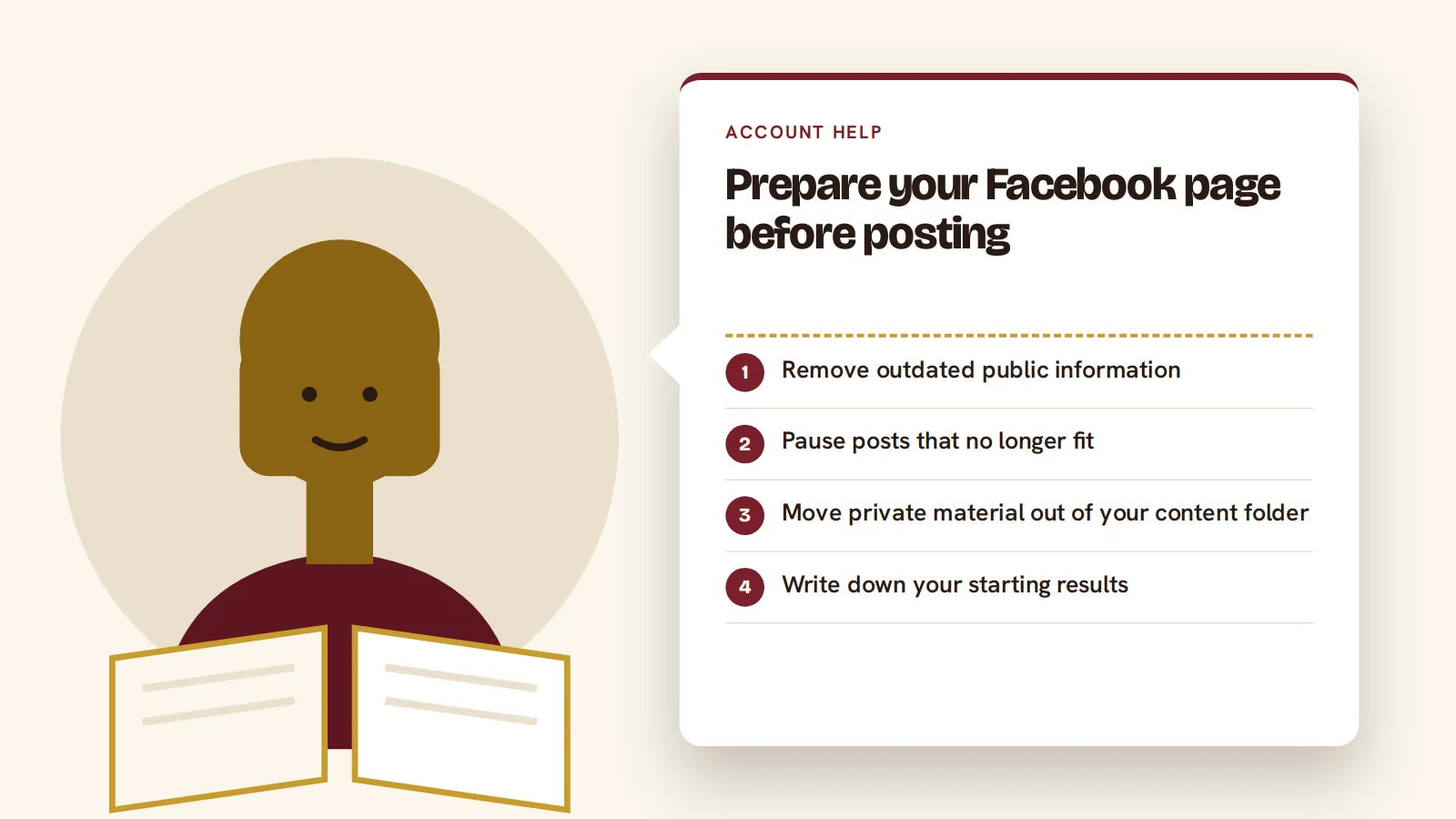
Clear up confusing details before bringing new people to the Page.
- Remove outdated public information. Check your contact details, description, website destination, and any hours that apply. Visitors shouldn’t need to guess which address or offer is current, especially when an older post still appears in search. Open the website link on your phone and confirm that it reaches the intended page, not an expired promotion or error screen.
- Pause posts that no longer fit. Review scheduled content before changing direction. Otherwise, an old promotion can interrupt your new message and send readers toward an offer you’ve already stopped providing. Check any connected scheduling tool too; reviewing Facebook alone may miss posts queued elsewhere.
- Move private material out of your content folder. Keep customer details, private messages, and unpublished business documents separate from approved assets. Ask the account owner or privacy adviser before publishing material whose permission status isn’t clear. Check screenshots for visible names, email addresses, and order details before approving them.
- Write down your starting results. Record your current follower total and available results for your chosen reporting period. Skipping this leaves you unable to tell whether your next content plan improved anything. Note any paid promotion so you don’t mistake purchased reach for organic growth.
Build your Facebook audience step by step
Start with a publishing plan you can maintain alongside your other work. The aim isn’t to fill every possible slot; it’s to discover which useful ideas bring the right people back.
-
Choose one primary audience. Write one sentence naming the people you serve and the problem you help them solve. Use actual customer questions or conversations rather than an imagined broad audience. This step is complete when you can reject an unrelated post idea without debating whether “everyone” might enjoy it.
-
Choose one main growth goal. Decide whether you’re trying to attract relevant followers, start conversations, generate inquiries, or bring people to a website. Pick one primary result for the next reporting period. You’ll know the goal is clear when you can name the action you want a reader to take after seeing your content.
-
Rewrite your Page description around that audience. Explain what you offer and what followers can expect from your posts. Use the space available in your current Page interface rather than forcing a fixed word count. The description works when a new visitor can understand your subject without opening several posts for context.
-
Build a list of real content questions. Collect questions from comments, emails, sales conversations, or support requests that you’re allowed to use. Remove private details before putting them into your planning document. Stop collecting when you have a question for each available publishing slot in your first calendar, rather than an oversized list you’ll never use.
-
Create one useful post for each planned slot. Answer a specific question, demonstrate a process, or explain a choice your audience faces. Give the answer before adding background, and use original images or examples when they help. A draft is ready when someone can gain something useful without needing to contact you for the missing explanation.
-
Choose the format that fits each idea. If movement explains the answer, use video; if readers need to inspect details, use a clear image or text. Video takes more production effort, while text is easier to revise and scan. The right choice is the format that explains the point clearly within your available time.
-
Publish on a manageable schedule. Put each finished post into a specific calendar slot, allowing time afterward to respond. Choose the number of slots from your actual production capacity, not another Page’s output. You’re ready to publish when the post, its destination links, and any relevant dates are correct in the preview.
-
Answer genuine responses with useful replies. Address the person’s question rather than leaving the same short response under every comment. Where appropriate, ask one relevant follow-up that helps clarify their problem. This step is complete when the conversation has a useful answer or a clear next destination, not merely a reaction from the Page.
-
Review results before planning the next batch. Compare posts from the same reporting window using the goal you selected earlier. Note the topic, format, audience response, and production effort in your tracker. Choose the next idea from a pattern across comparable posts, rather than rebuilding your entire plan around one unusually popular result.
Ways to bring real people to your Page
Good posts need people to find them. These free steps help the right readers discover your Page.
- Link to your Page from your website, email signature, and newsletter, so people who already know you can follow it.
- Add the Page link to your other social profiles and video descriptions, where relevant.
- Where Facebook shows an option to invite people who reacted to a post, use it sparingly and only for people who showed real interest. The option may not appear for every Page or post.
- Take part in Facebook Groups on your topic by answering questions helpfully. Check each group’s rules first, and don’t post links just to promote your Page.
- Try short video, such as Reels, if it suits your topic. Treat it as a test and compare it with your other posts, because reach is never guaranteed.
Track where new followers seem to come from, so you can repeat what works.
Signs your Facebook page is growing well
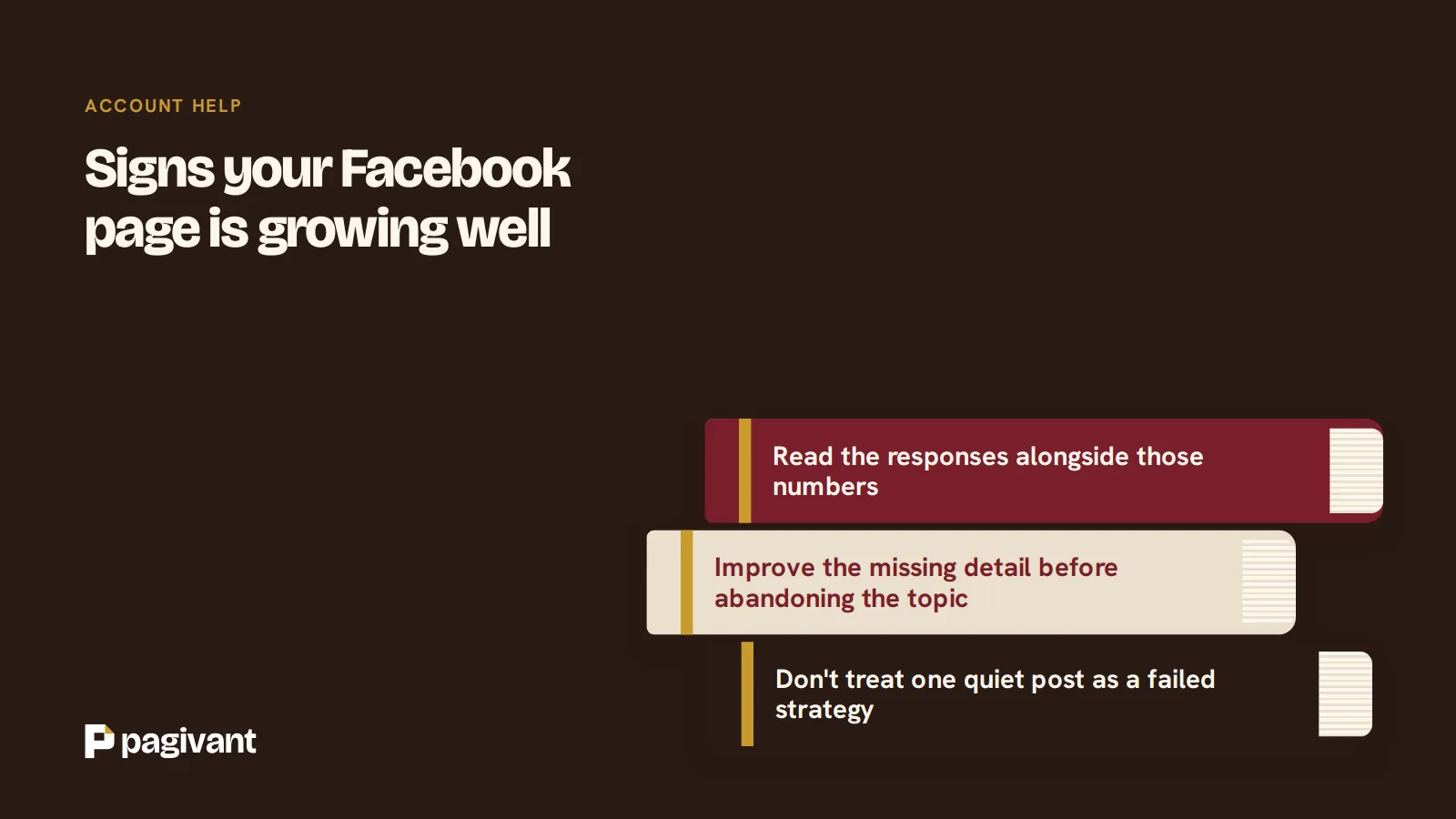
Good growth means more of the right people are taking actions that fit your goal. A rising follower total is useful, but it doesn’t tell you whether those people understand your offer or want to hear from you.
Check your available Page insights for reach, interactions, follows, and relevant destination actions. Metric names and availability vary by Page and interface; read your own values in Meta Business Suite’s Insights area. Keep the reporting dates consistent so you’re not comparing a short window with a much longer one.
Read the responses alongside those numbers. Specific questions, relevant inquiries, and comments that refer to the actual post can help explain what the totals mean. These aren’t proof of sales, so check your inquiry or order records before claiming a business result.
A second round is worthwhile when the topic draws interest but the next action remains unclear. For example, readers may ask where to find something that the post was supposed to explain. Improve the missing detail before abandoning the topic.
Don’t treat one quiet post as a failed strategy. Repeat the useful idea with a clearer opening or better-fitting format, then compare it with similar posts. If attention rises but relevant actions don’t, reconsider the audience fit rather than simply publishing more.
Fix common Facebook page growth problems
Start with the problem you can actually observe, not a rumor about how Facebook ranks posts. Check your own content and account notices before assuming that low reach means your Page has been restricted.
| What happened | Why | What to do |
|---|---|---|
| Visitors don’t follow | Page promise may be unclear | Explain what followers will receive |
| Posts get irrelevant comments | Topic may attract the wrong audience | Narrow the subject and opening |
| Reach rises without inquiries | Content may miss buying questions | Address relevant questions before the offer |
| Publishing keeps stopping | Production plan exceeds available time | Reduce slots or simplify formats |
| Followers rise after a giveaway | Prize may attract prize-only interest | Review later engagement before repeating |
| Publishing suddenly becomes unavailable | Access or account restrictions may apply | Check official notices and support options |
Buying numbers won’t fix these problems. The FTC’s consumer reviews rule guidance explains restrictions on buying fake social media indicators for commercial misrepresentation, including indicators a buyer knew or should have known were fake.
How often to post on Facebook
Use a weekly planning cycle, with a publishing count based on what you can produce and support. For a solo Page owner, two useful posts per week can be a workable starting plan—not a Facebook ranking requirement or a promise of growth.
The first factor is production effort. A detailed demonstration may need preparation, filming, and editing, while a direct answer to a customer question may take far less work. If your planned posts keep missing their slots, reduce the count before lowering their usefulness.
The second factor is audience response. A post that starts an active discussion needs follow-up time, so leave room for replies instead of scheduling every available minute for creation. Check response activity whenever you return to manage the Page.
Match your review to the post’s purpose. For a customer-service post, look for resolved questions; for a website promotion, check link clicks rather than treating likes as the result. Compare similar formats and goals, and separate paid results from organic results. A boosted post isn’t a fair benchmark for deciding whether your unpaid posting schedule works.
Review your calendar weekly, but judge content patterns across comparable reporting periods. Don’t change direction just because one post starts slowly. Increase your publishing pace only when you have additional useful material and enough time to handle the response; otherwise, keep the smaller schedule.
Prefer a done-for-you option? Read about Facebook Page Setup.
Frequently asked questions
Can I grow a Facebook page without showing my face?
Yes, you can build a useful Page without appearing on camera. Product demonstrations, screen recordings, diagrams, written explanations, and permission-based customer examples can all give people a reason to follow. Your audience still needs a clear sense of who operates the Page and how to contact you.
Why are my Facebook followers not seeing my posts?
Following your Page doesn’t guarantee that every follower will see every post in their Feed. Meta describes Feed ranking as a personalized process, so your follower total isn’t a delivery count. Avoid diagnosing a hidden restriction from low engagement alone; your account’s official notices are a better starting point.
How long does it take to get my first Facebook follower?
Your starting audience determines the wait, so check your Page’s follower count and available follow data rather than relying on a promised deadline. A business with existing customers has a different starting point from a new project with no outside audience.
Is it safe to use an app that promises free Facebook followers?
Don’t give an unfamiliar follower app your Facebook login or account access. Meta’s Help Center provides guidance on phishing and suspicious account access, including official recovery guidance if you’ve already shared credentials. For legitimate publishing tools, inspect the requested permissions and the provider’s documentation before connecting anything.
What happens if I stop posting on my Facebook page?
Your Page won’t automatically become useful again just because you return to posting, but a pause doesn’t mean you must start over. Your public information, offers, and scheduled content may need updating. If the business itself is temporarily unavailable, make that clear wherever visitors look for contact details.
Does it matter if I have more likes than followers?
No, that difference alone doesn’t tell you whether the Page is performing well. Likes and follows describe different relationships, and the options people see can vary with the Page experience. Use the labels and explanations in your own dashboard rather than assuming the totals should match.
What to do next
Set a simple review time on your calendar and use it to decide what deserves more attention next. Keep testing small changes, listen to the people who respond, and let your page grow at a pace you can maintain. You don’t need perfect results—just a clear direction and steady follow-through.

Derek Campbell writes about Facebook features, tools, and account management, covering topics such as account troubleshooting, Business Manager, Facebook Marketplace, and outreach strategies. His content also explores Facebook Groups, community engagement, and ways to connect with relevant audiences. His writing emphasizes practical Facebook know-how, from navigating Marketplace and managing business communities to building meaningful connections through Groups and outreach.
Checked against Facebook’s own help and policy pages on the date shown above.