How to Sell a Car on Facebook Marketplace


How to sell a car on facebook marketplace is to post honest details, verify the buyer, meet safely, and complete payment and title paperwork before handing over the keys. A clear listing and a realistic price usually bring better messages than a flashy description.
Your state’s title rules, the car’s condition, and the buyer’s payment method can change the process. This guide assumes you own the car, have its title or approved replacement documents, and are selling it privately in the United States.
Who Facebook car sales suit
This guide suits an owner with a private-party car, a clean way to photograph it, and enough time to answer questions. You’ll need the year, make, model, mileage, title status, vehicle identification number, and a clear idea of the lowest price you’ll accept.
A seller with a loan needs a different plan. The lender may hold the title, so you’ll need to ask about the payoff amount and title release before promising a buyer an immediate transfer. Your lender can explain its exact process.
A person selling a car with a rebuilt title, serious damage, missing paperwork, or an unresolved ownership dispute also needs extra help. The state motor vehicle agency can tell you what disclosures and documents apply in your state.
This page serves best if you can meet a buyer safely and complete the sale in person. If you’re a dealer, selling several cars, or trying to export a vehicle, read the rules for that business instead. The advice below assumes the car is in your possession and legally yours to sell.
What changes the sale
The title status matters most. A clean title is easier to explain than a salvage, rebuilt, flood, or branded title. Read the title itself and compare the owner name with your government ID; if they don’t match, stop and fix that before listing.
The car’s condition controls both price and buyer interest. Check the warning lights, tires, glass, air conditioning, odometer, service records, and visible damage. A buyer may accept a defect, but they’ll react badly if the listing hides it.
Your asking price should match similar private-party cars in your area. Compare the same model year, trim, mileage, drivetrain, title status, and condition. A lower price can bring faster replies, while a higher price gives you more room to negotiate but may reduce serious messages.
Location and meeting conditions also change the result. A buyer who must travel several hours may ask for a discount or remote payment plan. Keep the meeting local when possible, and use a public place with good lighting and other people nearby.
The point sellers get wrong most often is the difference between a listing price and a selling price. If you need a quick sale, price near comparable private listings; if you can wait, leave a small negotiation margin without hiding known defects.
How to list and sell your car on Facebook Marketplace
Use these steps for a normal private sale with an available title. If your lender holds the title, the buyer wants an out-of-state transfer, or the title has a problem, pause at Step 2 and ask the lender or state motor vehicle agency for the correct process.
- Gather the documents. Put the title, maintenance records, registration, loan information, and owner ID together. The names and vehicle identification number should match across the documents.
- Inspect the car. Check the tires, lights, fluids, glass, warning lamps, and interior. Write down every known defect before taking photos.
- Check the vehicle history. Search the VIN for open safety recalls using NHTSA’s recall lookup tool. Save the result and tell the buyer about any unresolved recall.
- Set the price. Compare at least three nearby listings with the same year, trim, mileage range, and title condition. Choose an asking price and a private minimum price.
- Clean and photograph it. Take daylight photos of every side, the interior, tires, odometer, engine bay, VIN plate, title brands, and damage. The photos should match the car’s current condition.
- Create the listing. Add the year, make, model, trim, mileage, title status, location, price, defects, service records, and preferred contact method. State clearly whether the price is firm.
- Screen each buyer. Ask when they can see the car and whether they understand the title status and price. Don’t send a verification code, refund a payment, or accept a story about a distant agent.
- Arrange the meeting. Choose a public location during daylight and bring another adult. Let the buyer inspect and test-drive the car only after checking their driver’s license and agreeing on the route.
- Complete payment and paperwork. Confirm cleared funds before signing over the title or releasing the car. Complete the bill of sale, odometer section, release-of-liability form, and plate removal steps required by your state.
- Finish the account records. Remove the listing, save copies of the signed documents, and notify your insurer and state motor vehicle agency as required. The sale is finished only when your records show the transfer.
The key judgment is whether the money is truly available, not whether a payment message looks real. If the funds haven’t cleared through a method you can verify yourself, don’t sign, hand over keys, or let the car leave.
Sale situations compared
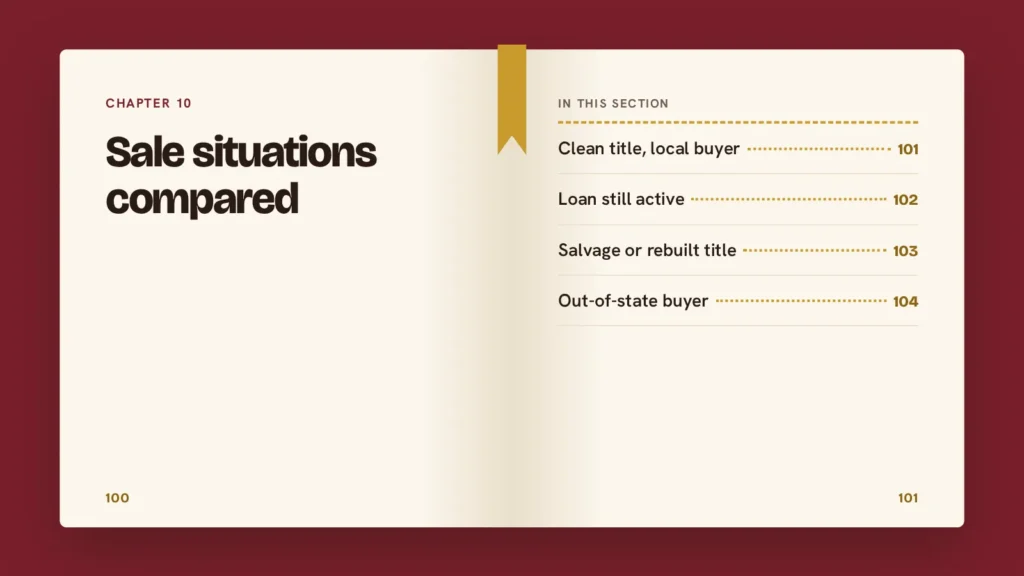
Your best method depends on the title, buyer, and urgency. Use the row that matches your situation instead of forcing every sale through the same process.
| Situation | What to do in it | What it takes | What to watch for |
|---|---|---|---|
| Clean title, local buyer | Meet and transfer documents | One prepared meeting | Payment must clear |
| Loan still active | Contact lender first | Extra payoff coordination | Title may be held |
| Salvage or rebuilt title | Disclose title brand clearly | More buyer questions | Never call it clean |
| Out-of-state buyer | Check both states’ rules | More paperwork and travel | Registration requirements |
| Urgent sale | Price near comparable cars | Less negotiation room | Scam pressure increases |
| Buyer wants financing | Use buyer’s lender process | Verification and waiting | Don’t release early |
| Trade-in alternative | Compare dealer offers | Less private-sale effort | Lower possible proceeds |
Details that protect the sale
Prepare the evidence
A strong listing answers the questions buyers ask before they travel. Include the exact mileage, title type, recent repairs, warning lights, tire condition, accident information you know, and whether the car has a loan.
Take one photo of each known problem. That feels less attractive, but it reduces arguments later. Keep service invoices together, and cross out personal information before sharing records online.
Control the inspection
Let the buyer inspect the car without rushing them, but keep the keys and documents under your control. A test drive should use an agreed route, and the buyer should show a valid driver’s license before driving.
Don’t reset warning lights, remove a dashboard bulb, warm up the engine to hide a cold-start issue, or erase service history. The short-term benefit can become a cancelled sale, a complaint, or a dispute over deception.
A clean-looking car isn’t the same as a sound car. If a buyer wants a mechanic’s inspection, agree on a nearby shop and decide in advance who pays. If the shop finds a serious issue, let the buyer walk away rather than arguing about the result.
Common Facebook car sale problems

The visible problem usually points to the next safe check. Don’t treat a buyer’s urgency or a payment screenshot as proof that the sale is genuine.
| What you notice | What it usually means | What to do first | How to stop it happening again |
|---|---|---|---|
| Buyer sends a payment screenshot | Payment isn’t verified | Check your account directly | Accept cleared funds only |
| Buyer asks for a code | Account takeover attempt | Stop replying immediately | Never share login codes |
| Messages ask for your email | Possible phishing attempt | Use Marketplace messages | Avoid unfamiliar payment links |
| Buyer offers above asking | Scam or unusual pressure | Decline and report account | Keep terms simple and local |
| Buyer refuses inspection | Risky rushed transaction | End the meeting plan | Require an in-person inspection |
| Title name doesn’t match | Ownership problem exists | Contact your DMV | Fix documents before listing |
| Warning light appears | Car needs honest disclosure | Photograph and describe it | Don’t erase the warning |
Rules for private car sales
Private-sale rules differ by state, so check your state motor vehicle agency’s pages for title transfer, odometer disclosure, plates, sales tax, and release-of-liability requirements. A form that works in one state may be missing information in another.
The Federal Trade Commission’s Used Car Rule generally applies to dealers, not ordinary private sellers. That doesn’t remove state duties or protect a seller who lies about mileage, title brands, damage, or known defects.
The signed title often isn’t the only required document. Your state may require a bill of sale, a notice of sale, an emissions document, a lien release, or a separate odometer statement. Don’t guess; use the vehicle agency’s private-sale checklist for your state.
Stop the transaction if the title is forged, the VIN differs, a lien remains unexplained, or someone asks you to misstate the sale price. A DMV, licensed title professional, or attorney should handle that problem rather than a casual Marketplace exchange.
The real cost of selling
The money you receive is only one part of the result. Cleaning, photographing, answering messages, meeting buyers, arranging inspections, and completing paperwork all take time, while an inaccurate listing can cost you more through repeated meetings or a failed sale.
Your likely selling price moves with mileage, trim, title status, service records, local supply, season, and visible damage. Compare at least three similar local listings, then adjust for differences you can prove from the car and its documents.
The lowest asking price isn’t always the best choice. A low price may reduce waiting and negotiation, but it can also attract more suspicious messages. A higher price may protect your target amount, but you’ll need patience and clear evidence for the number.
Check current registration, title, tax, and inspection fees on your state motor vehicle agency’s website. Those amounts change by state and sometimes by county, so a national figure would mislead you.
After the car leaves
Save photos of the signed title, bill of sale, odometer statement, payment confirmation, and buyer’s contact details. Keep them together until your state confirms the transfer or your insurer confirms the policy change.
Remove your license plate if your state requires it, then submit the notice of sale or release-of-liability form through the state motor vehicle agency. Don’t assume the buyer’s registration automatically removes your responsibility.
Tell your insurer when the sale is complete, and ask when coverage ends. Canceling too early can create a coverage gap if the buyer drives away before the transfer is recorded.
If the buyer later claims a problem, return to the signed paperwork and the listing photos. If you knowingly hid a major defect or made a false statement, get legal advice instead of trying to rewrite the agreement through Marketplace messages.
When Facebook Marketplace is wrong
Facebook Marketplace isn’t a good choice if you can’t verify ownership, show the car safely, or meet a buyer without pressure. Use a licensed dealer or title professional when the title is missing, a lien is unresolved, or ownership has changed through an estate.
It’s also a poor fit for a car needing major repairs that you can’t describe accurately. A licensed salvage buyer, mechanic, or dealer may give you a lower offer but can handle transport and condition questions.
Skip a private sale if a buyer wants you to misstate the price, mileage, title, or purchase date. End the deal and ask your state motor vehicle agency or an attorney what to do next.
When you want it set up without the guesswork, Facebook Marketplace Account Setup is the place to start.
Frequently asked questions
Can I sell a car on Facebook Marketplace without the title?
Usually, you shouldn’t complete a private sale without the title or state-approved replacement paperwork. The exact rule depends on your state and any lien. Contact the state motor vehicle agency before listing, because a buyer can’t reliably register a car from incomplete ownership documents.
Why is my Facebook car listing getting no serious buyers?
The price, location, photos, title status, or missing details may be reducing trust. Compare your listing with three similar local cars, add damage and mileage photos, and state the title condition clearly. If messages remain weak, test a lower price based on those comparisons.
How long does it take to sell a car on Facebook Marketplace?
A private sale can take from one day to several weeks, but no honest fixed time applies to every car. The main variables are price, local demand, title condition, mileage, and how quickly you answer serious messages.
Is it safe to let a Facebook buyer test-drive my car?
It can be safer with a public daytime meeting, a valid driver’s license check, an agreed route, and another adult present. Don’t allow a test drive if the buyer refuses identification, wants to drive alone, or creates pressure.
What happens if a buyer wants to pay with a cashier’s check?
A cashier’s check can still be fraudulent, so don’t release the car based only on the paper. Call the issuing bank using a number you find independently, verify the funds, and wait until your own bank confirms the deposit is cleared.
Does it matter if the car has an open recall?
Yes, disclose the open recall and give the buyer the available recall information. NHTSA’s VIN lookup can show whether a safety recall appears in its system, but the vehicle maker or dealer can provide the repair details.
Can I remove the Facebook listing after selling the car?
Yes, remove it after the payment and paperwork are complete. Save the listing, messages, photos, and signed documents first, because they may help explain what was advertised if a disagreement appears later.
Start the Facebook car sale
First, gather the title, VIN, records, and honest condition details before creating the listing. Expect the right buyer to ask questions, inspect the car, and verify payment before signing. Stop and get help if ownership, lien, payment, or title information doesn’t match.

Derek Campbell writes about Facebook features, tools, and account management, covering topics such as account troubleshooting, Business Manager, Facebook Marketplace, and outreach strategies. His content also explores Facebook Groups, community engagement, and ways to connect with relevant audiences. His writing emphasizes practical Facebook know-how, from navigating Marketplace and managing business communities to building meaningful connections through Groups and outreach.
Checked against Facebook’s own help and policy pages on the date shown above.