Membership Questions That Filter Members on Facebook

Effective Facebook membership questions are short, specific prompts that stop bots and unqualified leads before they join. These gatekeepers ensure only people who read rules and share niche interests gain access. They separate casual scrollers from engaged members by requiring small effort. Good questions verify identity or agreement, keeping your feed clean and engagement high without constant manual moderation.
Membership questions that filter members
You can use various question types to screen applicants based on your group’s goals. The table below outlines the most common types, their objectives, and real examples of how they appear to users.
| Question Type | Best For | Example |
|---|---|---|
| Rule Agreement | Ensuring safety and compliance | Type “I agree” to accept the rules |
| Niche Verification | Keeping out unrelated spammers | What is your current job title? |
| Bot Detection | Stopping automated spam accounts | What is 2 plus 3? |
| Intent Check | Finding serious participants only | Why do you want to join? |
| Location Filter | Local community groups only | Which city do you live in? |
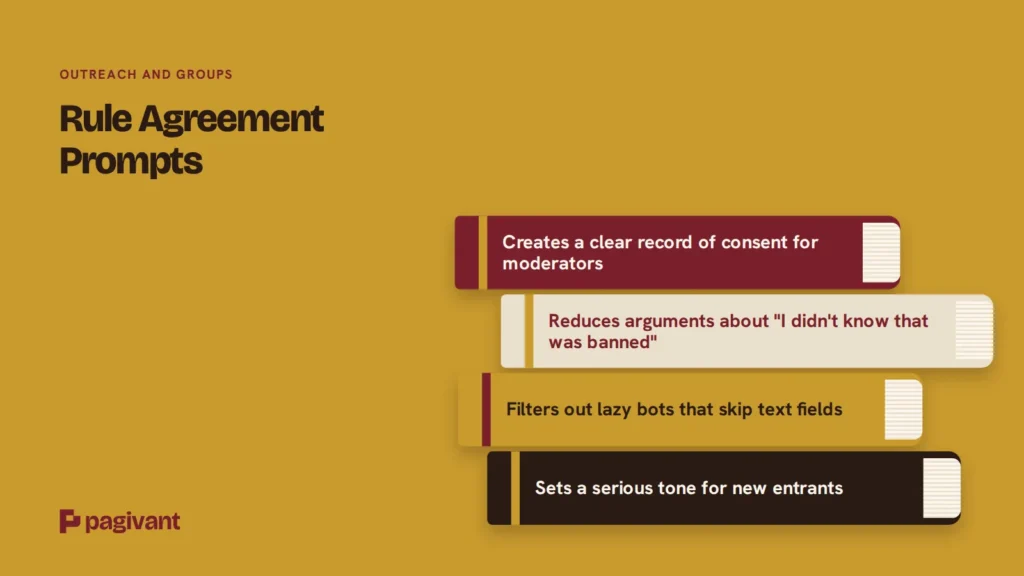
Rule Agreement Prompts
Rule agreement prompts are the simplest way to ensure every member has seen your community guidelines. This type of question doesn’t test knowledge but confirms consent. It suits any group where safety, respect, or specific posting rules are critical to survival.
If you run a support group, a buy-and-sell market, or a professional network, this is your first line of defense. It works because it creates a psychological contract; the user must actively type a phrase to proceed, which makes them slightly more accountable for their future behavior.
- Creates a clear record of consent for moderators
- Reduces arguments about “I didn’t know that was banned”
- Filters out lazy bots that skip text fields
- Sets a serious tone for new entrants
For example, you might ask: “Type ‘I have read the rules’ to confirm you won’t post spam.” This requires the user to copy specific text, proving they paid attention to the instruction. If they type “yes” or “ok,” you can decline them and point them back to the prompt.
This method isn’t foolproof against determined humans, but it stops the majority of low-effort spam scripts. It also helps when you need to remove someone later; you can remind them they explicitly agreed to the terms. Use this as your first question, followed by more specific filters. It takes seconds to answer but adds a layer of friction that many spammers avoid.
Niche Verification Questions
Niche verification questions test whether the applicant actually belongs in your specific community. Unlike rule agreements, these require the user to provide personal or professional information. This suits groups built around a hobby, industry, or local area where outsider content dilutes the value.
If you run a group for graphic designers, asking for their primary software tool separates pros from curious beginners. If you manage a parents’ group, asking for the age of their youngest child ensures relevance. This method filters out marketers who scrape groups for leads but know nothing about the topic.
- Ensures content remains relevant to the core audience
- Stops competitors from spying on your community
- Helps moderators segment members for future posts
- Builds immediate trust among verified peers
For instance, a vegan baking group might ask about favorite egg substitutes. Real bakers answer “flax eggs” or “applesauce,” while spammers leave blanks or write “hello.” You can auto-approve specific keywords for high volume or review manually for quality. This reveals expertise and provides welcome post conversation starters. Avoid asking for sensitive data like addresses to maintain privacy and trust.
Bot Detection Checks
Bot detection checks are simple logic or math questions designed to stop automated scripts. These questions are useless for human screening but highly effective against mass-invite spam tools. They suit any public group that receives frequent spam attacks.
The question should be easy for a human but hard for a basic bot to parse. This isn’t about intelligence; it’s about verifying humanity. If you don’t use these, you may spend hours deleting crypto scams and fake profile links. This method is a pure utility filter with no community-building value, so pair it with other questions.
- Eliminates 90% of automated spam accounts
- Requires zero mental effort from genuine users
- Protects your group from sudden influxes of junk
- Saves moderator time on daily cleanup tasks
A concrete example is: “What is 5 + 4?” The answer is always 9. You can change the numbers weekly to prevent bots from learning the pattern. Another option is “What color is the sky?” With the expected answer “blue.” These questions are boring but necessary. If a user fails this, they’re almost certainly a bot.
Don’t use complex riddles, as these frustrate real people, especially non-native speakers. Keep it to basic arithmetic or obvious facts. This question should be last in your sequence, acting as a final gate. It ensures that even if a spammer gets past the niche questions, they hit a wall here.
Common Screening Mistakes

Many group owners make the mistake of asking too many questions or making them too hard. This creates friction that drives away good members. If you ask five long-form questions, people will quit halfway through. If you ask obscure trivia, you filter out knowledgeable people who just don’t know that specific fact.
The cost of this mistake is a stagnant group with low growth and poor diversity. You want barriers for spammers, not for humans. Another error isn’t reviewing answers regularly. Auto-approving everyone defeats the purpose of the questions. You must check the responses at least once a week to refine your filters.
- Too many questions cause drop-offs in applications
- Hard questions exclude quiet but valuable members
- Ignoring answers leads to spam infiltration
- Vague questions yield useless data for moderation
For example, asking “Tell us about yourself” often yields blank or copy-pasted answers. Rewrite questions if many people fail, as wording may be confusing. Track approval rates; if they drop below 50%, adjust questions to match ideal member behavior. This balance keeps the group safe without feeling exclusive.
Other Useful Filters
- Location Specifics help local groups verify residency. Ask for the nearest major landmark or zip code. This stops people from other countries joining local buy-sell groups. It ensures meetups and trades are geographically possible. Use this only if physical proximity is essential to your group’s function.
- Referral Sources track where your best members come from. Ask “How did you hear about us?” to understand which marketing channels work. If most members come from Instagram, focus efforts there. This doesn’t filter spam but improves your growth strategy over time.
- Experience Level segments professionals by skill. Ask “How many years have you worked in this field?” This helps you tailor content. Beginners need different advice than experts. It allows you to create sub-groups or targeted posts later. Use ranges like “0-2 years” to keep it simple.
- Content Consent clarifies posting rights. Ask “Do you allow us to share your posts on our page?” This protects your legal standing. It ensures you have permission to feature member content. It filters out people who are overly protective or unaware of social media norms. Keep it yes/no for ease.
How to Choose Your Questions
Choosing the right questions depends on your group’s size, niche, and risk level. If you have a small, private group of friends, you may need no questions at all. Trust is already established. But if you run a large public group for cryptocurrency traders, you need heavy filtering.
The risk of scams is high, so use rule agreements and bot checks. For a hobby group like knitting, niche verification works best. You want to ensure people actually knit, not just sell yarn. Consider your moderation capacity. If you have one admin, keep questions simple and auto-approve where safe. If you have a team, you can handle open-ended questions.
The trade-off is between security and growth. Strict filters keep spam out but slow down new member intake. Loose filters grow fast but require constant cleanup. Start with two questions: one rule agreement and one niche check. Monitor the results for a month. If you see spam, add a bot check.
If you see irrelevant posts, tighten the niche question. Don’t combine all types unless necessary. Too many steps confuse users. Pick the one or two that address your biggest pain point. For most groups, verifying interest and consent is enough. You can always add more later if problems arise. Never make the process harder than it needs to be.
If you would rather have this handled for you, our Facebook Accounts Setup service covers it end to end.
Frequently asked questions
How many questions should I ask?
Ask two or three questions maximum to prevent user abandonment. The first should confirm rule agreement, and the second should verify niche interest. Add a bot check only if spam is an issue. Keep forms short to respect time, as long processes deter casual joiners. Focus on question quality, not quantity, and gather further details after joining.
Can I auto-approve members?
Yes, but only if you trust your screening questions. Set up auto-approval for answers matching specific keywords like “I agree” to save time. This risks letting in smart spammers, so review auto-approved members occasionally. Manual review is safer for high-risk niches. Always have a plan to quickly remove bad actors if they slip through the automated filter.
What if someone lies in their answer?
You can’t stop all liars, but most spammers are lazy and leave blanks or gibberish. A lie requires effort that bots rarely expend. If a human lies, they often reveal themselves through poor behavior later. Watch posting patterns rather than just entry answers. Ban anyone posting links immediately. Use questions as a filter combined with active moderation for best results.
Is it safe to ask for personal info?
No, never ask for passwords, full addresses, or phone numbers. This violates Facebook’s policies and puts members at risk. Stick to general info like city or hobby experience. Request detailed information via private message after joining. Keeping the entry barrier low and safe builds trust over time. Asking for sensitive data early scares away legitimate users and attracts scammers.
How often should I change questions?
Change questions every few months if spam gets through, as spammers share bypass methods. Rotating questions keeps them guessing. Keep niche questions stable so regulars can help newbies, but change bot checks weekly. Monitor declined lists for common wrong answers. Simplify questions if many real people fail. Balance security with usability to show your group is active and well-managed.
Does the order of questions matter?
Yes, put the easiest question first to secure a quick win with the rule agreement. Follow with the niche question requiring thought, and end with the bot check. This flow builds momentum, whereas starting hard may cause users to quit. Order affects completion rates, so test sequences for your audience. Generally, placing low-friction items first and high-friction last optimizes conversion.
Next Steps for Your Group
Start by adding one rule agreement question to your group settings today. Go to your group dashboard, select “Settings,” and find “Membership Questions.” Add a prompt that requires users to type a specific phrase confirming they read the rules. Expect to see a drop in spam posts within 48 hours.
The sign that it’s working is fewer reports from members and less time spent deleting junk. If you still see irrelevant posts, add a niche verification question next. Ask something only a genuine enthusiast would know, like the name of a founder or a specific product detail. Bots can’t answer these contextual queries accurately.
Stop adding questions if your approval rate drops below 50%, indicating the barrier is too high. You’ll lose legitimate members frustrated by the process. Check pending requests daily for the first week, approving clear matches immediately. Ignore borderline cases until you spot patterns. Don’t automate approvals until you have manually vetted at least one hundred applicants to ensure quality.

Derek Campbell writes about Facebook features, tools, and account management, covering topics such as account troubleshooting, Business Manager, Facebook Marketplace, and outreach strategies. His content also explores Facebook Groups, community engagement, and ways to connect with relevant audiences. His writing emphasizes practical Facebook know-how, from navigating Marketplace and managing business communities to building meaningful connections through Groups and outreach.
Checked against Facebook’s own help and policy pages on the date shown above.